
Table of Contents
Advertising on Whole Foods Market requires a different approach than mass-market retail media.
Most retail media networks optimize primarily for scale, price comparison, and short purchase cycles. Whole Foods operates within a curated, premium grocery environment defined by ingredient standards, selective assortment, and an affluent, values-driven customer base. At the same time, it is owned by Amazon, meaning its advertising runs on the most advanced commerce media infrastructure available today.
This combination—premium retail positioning plus Amazon-scale ad technology—makes Whole Foods uniquely powerful in the retail media landscape.
Before diving into platform mechanics, we recommend reviewing our Amazon Ads Guide for technical foundations around Sponsored Ads, DSP, and reporting.
Why Whole Foods Is Structurally Different
Whole Foods is the largest U.S. grocery chain focused on better-for-you brands. Its ingredient standards and category review processes are selective and rigorous.
Being stocked signals:
- Ingredient integrity
- Regulatory and sourcing compliance
- Brand maturity
- Category credibility
Consumers understand that not every brand qualifies. Shelf presence therefore communicates quality before any media investment is made.
This matters because advertising operates in a context where baseline trust already exists.
A Premium, Affluent Shopper Base
Whole Foods customers typically:
- Over-index on household income
- Spend more per basket
- Prioritize clean labels and sourcing transparency
- Demonstrate strong repeat purchase behavior
Price matters, but quality and value alignment matter more.
Creative messaging should therefore emphasize formulation, functional benefits, sourcing standards, and brand narrative. Competing primarily on discount erodes positioning and is rarely necessary in this environment.
A Different Competitive Set
Whole Foods shelves are structured differently from conventional grocery.
You are unlikely to see flagship products from The Coca-Cola Company or PepsiCo dominating center aisle categories.
Instead, brands compete against other natural, organic, or functional alternatives.
The competitive dynamic shifts toward:
- Ingredient quality
- Product innovation
- Brand story
- Packaging clarity
- Lifestyle alignment
For challenger brands, this is significant. In many categories, competition is challenger versus challenger, not challenger versus multinational incumbent. Advertising supports differentiation within a curated field rather than defending against scale-driven giants.
The Amazon Infrastructure Effect
Whole Foods advertising runs through Amazon’s ad stack.
This provides access to:
- Sponsored Products
- Sponsored Brands
- Sponsored Display
- Amazon DSP
- Keyword-level reporting
- Behavioral audience targeting
- Deterministic attribution
Most grocery retail media networks are limited to on-site placements and loyalty data. Whole Foods benefits from Amazon’s logged-in identity resolution, cross-device tracking, and unified reporting systems.
From a retail media capability perspective, this makes it one of the most advanced grocery-focused networks in operation.
Seamless Ecommerce and Prime Fulfillment
Whole Foods combines:
- Premium retail positioning
- Affluent, quality-focused shoppers
- Amazon-scale traffic
- Closed-loop attribution
Brands can activate search, audience targeting, and DSP placements while measuring performance within a unified system.
Scale derives from Amazon’s reach. Precision derives from first-party behavioral data. The retail environment reinforces brand credibility.
Few grocery retail media networks operate with this level of technological sophistication combined with premium shelf positioning.
What This Guide Covers
This guide explores the full Whole Foods advertising ecosystem, including:
- Sponsored Products
- Sponsored Brands
- Sponsored Display
- Amazon DSP integration
- In-store digital signage
You will learn:
- Targeting strategies aligned with the Whole Foods shopper
- Performance metrics relevant to premium grocery
- Retail readiness considerations
- Category-specific playbooks for:
- Food & Beverage
- Supplements & Wellness
- Household & Personal Care
Whole Foods represents a rare configuration in retail media: a curated, trust-based grocery environment embedded inside the most sophisticated commerce infrastructure in the market.
Advertising in this ecosystem should reflect both dimensions.
Whole Foods advertising ecosystem
Sponsored Products
Sponsored Products appear on Amazon search results and product detail pages when the ASIN meets specific eligibility criteria:
- Product is sold by Whole Foods Market or Amazon
- Inventory is Prime-eligible
- Product is available for delivery or pickup from Whole Foods locations
Key Differences from Standard Amazon Sponsored Products
|
Characteristic |
Standard Amazon |
Whole Foods |
|
Keyword Saturation |
High competition, costly bids |
Lower saturation, more efficient reach |
|
Conversion Trust |
Varies by seller reputation |
Higher baseline from WFM association |
|
Purchase Behavior |
One-time and subscription |
Strong replenishment patterns |
|
Best Categories |
All consumer products |
Pantry staples, beverages, supplements, household essentials |
Sponsored Brands
Sponsored Brands play a larger strategic role for Whole Foods brands than for mass-market sellers. The reason is fundamental: Whole Foods shoppers care about the brand behind the product. Discovery often precedes intent, and multi-SKU baskets are common.
Effective Sponsored Brands Campaigns Should:
- Lead to Brand Stores curated around values, not just products
- Emphasize ingredient philosophy and sourcing transparency
- Group SKUs by use-case rather than price tier
Sponsored Display
In November 2022, Amazon expanded Sponsored Display to Amazon Fresh and Whole Foods Market online stores. This launch opened new opportunities for brands to extend reach, page-visit, or conversion-optimized campaigns to grocery shoppers.
Sponsored Display Capabilities for Whole Foods
- Promote Amazon Fresh and Whole Foods Market offers across WFM, Fresh, and Amazon.com
- Target audiences based on shopping behavior and product views
- Retarget shoppers who have viewed or purchased similar products
Amazon DSP
For Whole Foods brands, DSP is not optional. It is the backbone of scalable growth. Through Amazon DSP, brands unlock capabilities that Sponsored Ads cannot provide.
DSP Capabilities for Whole Foods Brands
| Capability | Description | Strategic Value |
| Whole Foods Shopper Audiences | Target shoppers who purchased in WFM physical stores with custom lookback windows up to 365 days | Reach verified premium grocery shoppers |
| Category-Level Audiences | Target WFM shoppers by category: Produce, Dairy, Refrigerated, etc. | Precision targeting by shopping behavior |
| In-Store Attribution | Measure impact of digital ads on physical store purchases | Closed-loop measurement for omnichannel campaigns |
| Prime Video Placements | Video ads on Prime Video streaming content | Brand building with engaged audiences |
| WFM Walled Garden Display | Priority placements within WFM online environment | Premium visibility to high-intent shoppers |
| Off-Amazon Reach | Programmatic display across third-party exchanges | Extend reach beyond Amazon ecosystem |
DSP enables Whole Foods advertising to move from transactional capture to demand shaping—reaching consumers before they enter the purchase funnel and influencing their consideration set.
Specs for Whole Foods Ads on Amazon DSP
Desktop
| Display Size | Max. File Weight | File Format |
| 160×600 px | 40 kb static | JPG / PNG-8 |
| 300×250 px | 40 kb static | JPG / PNG-8 |
| 300×600 px | 50 kb static | JPG / PNG-8 |
| 728×90 px | 40 kb static | JPG / PNG-8 |
| 970×250 px | 200 kb static | JPG / PNG-8 |
Mobile
| Display Size | Creative Dimensions | Max. File Weight | File Format |
| 320 x 50 px | 640 x 100 px @2X (required) | 20 kb | JPG / PNG-8 |
| 414 x 125 px | 828 x 250 px @2X (required) | 100 kb | JPG / PNG-8 |
| 300 x 250 px | 600 x 500 px @2X (required) | 40 kb | JPG / PNG-8 |
| 728×90 | 1456 x 180 px @2X (required) | 40 kb | JPG / PNG-8 |
In-Store Digital Signage
As of April 2024, Amazon launched in-store digital signage advertising across Whole Foods Market and Amazon Fresh stores. This represents a significant expansion bridging digital and physical retail.
Digital Signage Key Features
- Available through Amazon DSP (self-service and managed service)
- Reaches customers at the shelf during active shopping
- Amazon research shows 16% boost in brand awareness and 12% increase in purchase intent
- Available to both endemic (grocery) and non-endemic advertisers with approval
Targeting Strategies for Whole Foods Ads
Understanding the Whole Foods Shopper
Whole Foods shoppers are not bargain hunters. They represent a distinct consumer profile with specific motivations:
- Ingredient-aware: they read labels and understand what goes into their food
- Health-motivated: wellness is a priority, not an afterthought
- Values-aligned: they want to support companies that share their environmental and social values
- More loyal once converted: higher lifetime value offsets higher acquisition costs
The Inverted Funnel Strategy
Effective targeting for Whole Foods brands prioritizes lifestyle clusters, dietary frameworks, health outcomes, and purchase behavior over search volume. In practice, this flips the classic Amazon advertising hierarchy:
| Traditional Amazon Hierarchy | Whole Foods Hierarchy |
| 1. Sponsored Products (bottom-funnel) | 1. DSP (top-funnel awareness) |
| 2. Sponsored Brands (mid-funnel) | 2. Sponsored Brands (mid-funnel education) |
| 3. DSP (top-funnel) | 3. Sponsored Products (bottom-funnel capture) |
Key Audience Segments
| Audience Segment | DSP Targeting Approach | Use Case |
| WFM Physical Store Purchasers | Custom audiences with 365-day lookback | Retargeting, loyalty building |
| Category Purchasers | LS-Whole Foods Market [Category] Offline Customers | Category conquest, cross-selling |
| Organic/Natural Lifestyle | Lifestyle segments for organic, clean-label shoppers | New customer acquisition |
| Health & Wellness Enthusiasts | In-market audiences for supplements, fitness | Awareness for wellness products |
| Prime Members in WFM Zipcodes | Geographic + Prime membership targeting | Drive store visits |
Whole Foods Metrics
Short-term efficiency metrics alone are misleading in the Whole Foods context. The premium shopper base and higher customer lifetime value require a different measurement framework..
Key Indicators
Amazon DSP provides in-store attribution for Whole Foods purchases made by Prime members. This closed-loop measurement enables:
- Tracking digital ad exposure to physical store purchases
- Geographic testing of campaigns before national rollout
- Understanding which digital placements drive in-store behavior
Brands that optimize only for immediate ROAS tend to underinvest in the very signals that Whole Foods shoppers reward. Patience and measurement sophistication are competitive advantages.
Retail Readiness Considerations
Whole Foods advertising amplifies strengths and exposes weaknesses. Before scaling spend, brands must have their foundation in place.
Whole Foods Quality Standards
Products sold at Whole Foods must meet rigorous quality standards:
- No artificial preservatives, colors, flavors, sweeteners, or hydrogenated fats
- Over 100+ ingredients on the unacceptable ingredients list
- Non-GMO claims require third-party verification (Non-GMO Project or USDA Organic)
- Regenerative Organic Certification (ROC) receives priority consideration
Retail Readiness Checklis
| Area | Requirement | Advertising Impact |
| Ingredient Compliance | All ingredients must be on WFM approved list | Ads for non-compliant products will be rejected |
| Labeling | Clear ingredient listing, compliant claims | Creative must match on-pack claims exactly |
| Supply Chain | Reliable inventory, 30-60 day lead times | Stock-outs waste ad spend and damage rankings |
| Packaging | Clear communication of value proposition | Creative extends packaging story |
| Margin Structure | Minimum 40% margin for grocery categories | Ensures profitability at scale |
| Insurance & Certification | Liability insurance, food safety certifications | Required for vendor status |
Key Principle: Advertising cannot compensate for misalignment with Whole Foods standards. It simply makes misalignment visible faster.
Category-Specific Strategic Playbooks
Food & Beverage
| Strategy Element | Approach |
| Primary Objective | Drive awareness, trial, and replenishment |
| DSP Focus | Awareness and education about ingredients, sourcing, health benefits |
| Sponsored Products | Capture replenishment searches for pantry staples |
| In-Store | Sampling where possible to drive trial |
| Key Metrics | NTB rate, repeat purchase velocity, basket size |
| Creative Emphasis | Origin stories, ingredient sourcing, functional benefits |
Supplements & Wellness
| Strategy Element | Approach |
| Primary Objective | Education-first approach building category credibility |
| DSP Focus | Target health-motivated audiences, avoid over-promising |
| Sponsored Products | Conservative claims, focus on compliant copy |
| Brand Store | Strong structure with educational content, certifications |
| Key Metrics | Customer lifetime value, subscription rate |
| Creative Emphasis | Third-party certifications, transparent sourcing, clinical studies |
Household & Personal Care
| Strategy Element | Approach |
| Primary Objective | Demonstrate value through sustainability and quality |
| DSP Focus | Sustainability proof points, eco-conscious audiences |
| Sponsored Products | Multi-SKU bundles for value signaling |
| In-Store | Packaging visibility, ingredient transparency |
| Key Metrics | Brand switching rate, multi-product adoption |
| Creative Emphasis | Environmental impact, clean ingredients, packaging sustainability |
Getting Started
Getting Started: Critical Mistake to Avoid
The most common and costly setup error is failing to create a dedicated Whole Foods Market (WFM) account, separate from your standard Amazon Seller account.
Whole Foods inventory does not sync automatically with a typical Amazon Seller Ads setup. If you do not follow the official WFM onboarding process—starting inside the WFM Supplier Portal (Grocery Central)—your Whole Foods–stocked products will appear as out of stock inside Amazon Ads.
When this happens, campaigns cannot serve, even though your products are physically available in Whole Foods stores.
To avoid this:
- Begin the setup inside the WFM Supplier Portal (Grocery Central).
- Follow the Whole Foods–specific onboarding instructions.
- Create a separate WFM advertising account.
Only after this process is completed will your WFM assortment populate correctly inside Amazon Ads.
How to Create Your WFM Amazon Ads Account
Once your dedicated WFM account is active:
- Log in to the WFM Supplier Portal.
- Navigate to Programs → Marketing.
- Click Create an Account.
- Complete the full setup process.
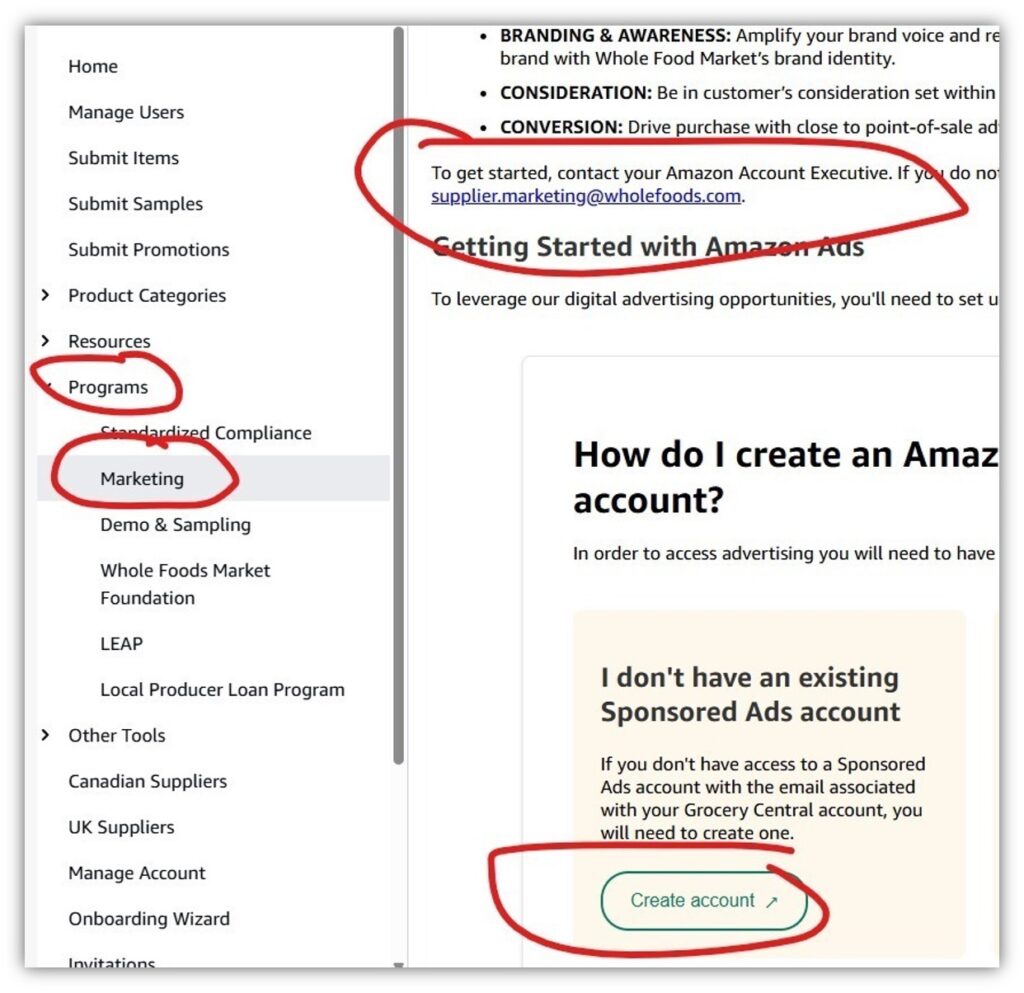
This creates a standalone WFM Amazon Ads account tied specifically to your Whole Foods assortment. From there, you will be able to run Sponsored Ads for products stocked in Whole Foods without inventory errors.
Skipping this separation step almost always results in campaign delays, rejected ads, or non-delivery. Setting up the correct account structure from the beginning prevents unnecessary troubleshooting later.
You are all set!
