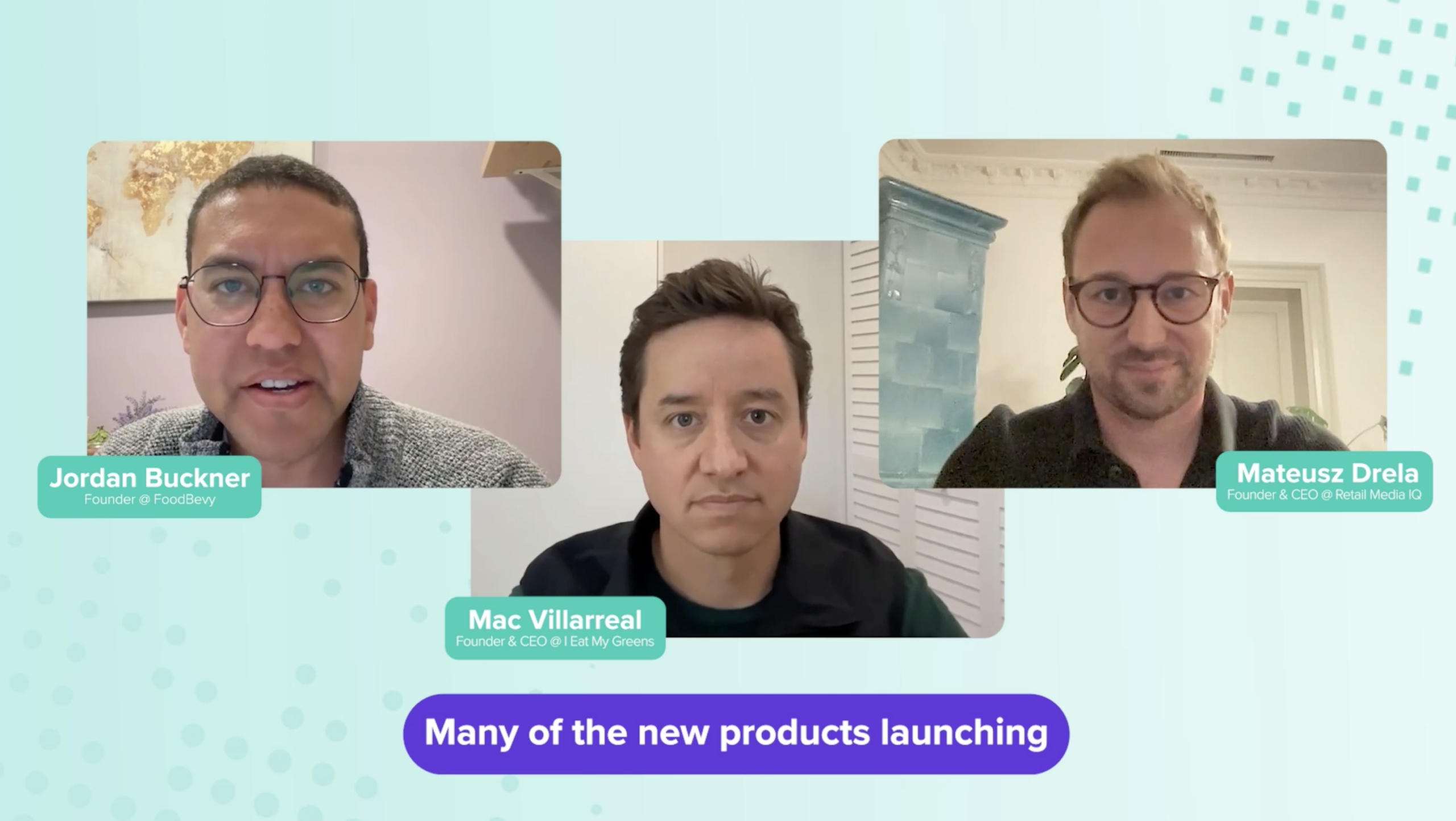
Mac Villarreal, Founder @ I Eat My Greens
Jordan Buckner, Founder @ FoodBevy
Matt Drela, Founder, CEO @ RMIQ
When I Eat My Greens wanted to improve the performance of its Instacart advertising, the campaigns were already generating sales — but the economics were not yet where the brand wanted them to be.
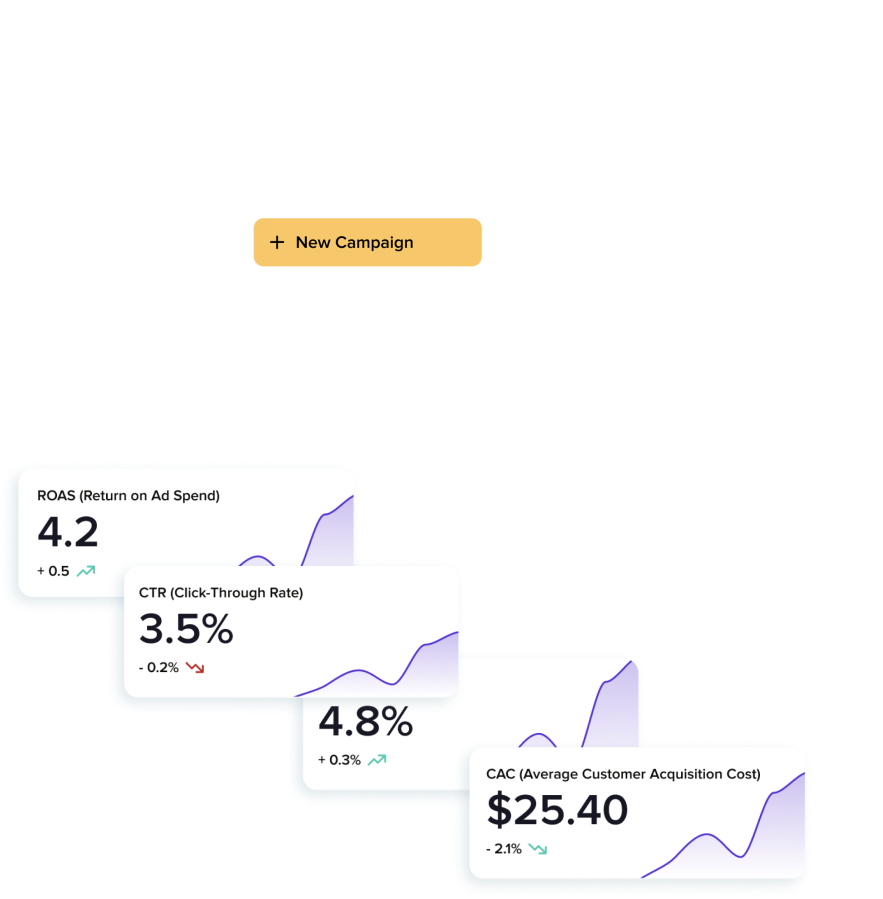
Working with RMIQ, the team focused on improving retail media effectiveness through more granular optimization of products, keywords, bids, and shopper relevance. As Mac Villa, founder of I Eat My Greens, explained in the interview, this helped improve ROAS and overall campaign KPIs compared with relying only on Instacart’s automated campaigns.
For a lean CPG team without a dedicated digital marketing expert, the collaboration gave I Eat My Greens a more efficient way to reach digital shoppers, drive sales, and support retail velocity.
Read the key lessons from the conversation between Mac Villarreal, founder of I Eat My Greens, Mat Drela, CEO & Founder of RMIQ, and Jordan Buckner, Founder @ FoodBevy — covering retail media effectiveness, Instacart advertising, campaign optimization, ROAS, customer acquisition, and retail velocity.
Why Retail Media Matters for CPG Brands
For emerging CPG brands, getting onto the shelf is only the beginning. The bigger challenge is generating enough sales velocity to stay there.
Traditional tactics such as demos, promotions, couponing, and in-store activity can help, but they can also be expensive and difficult to measure.
Retail media gives brands another option.
Platforms such as Instacart allow brands to advertise directly to shoppers while they are actively searching for products. Instead of generating awareness and hoping it eventually translates into sales, brands can connect advertising spend much more directly with purchases.
As Mat Drela explains, this makes it possible to see how much was spent on advertising, how much revenue was generated, and then continuously optimize campaign performance.
Retail Media Effectiveness Is About More Than Turning Campaigns On
One of the key lessons from I Eat My Greens is that launching retail media campaigns is relatively easy.
Instacart allows brands to set up automated campaigns quickly. But automation alone does not necessarily deliver the strongest results.
Before working with Retail Media IQ, I Eat My Greens was already advertising on Instacart and generating sales. The challenge was that the economics were not as strong as they could be.
The goal therefore became improving retail media effectiveness: making sure advertising generated sales at a level that worked for the brand’s margins and unit economics.
Instead of treating retail media as an advertising expense that might pay off later, the objective was to turn it into an ongoing growth engine.
How Retail Media Campaign Optimization Works
RMIQ’s approach comes from performance marketing.
The principle is simple: break performance down to the lowest level that can be controlled and optimized.
That includes:
- individual products
- keywords
- bids
- search relevance
- advertising efficiency
Different products perform differently. Different keywords perform differently. Different bids produce different results.
The objective is to identify what is efficient, reduce spend on what is not working, and improve the areas already producing sales.
For a brand like I Eat My Greens, that means helping its soups appear when shoppers make relevant searches while paying the appropriate amount to reach those shoppers.
According to Mat, retail media effectiveness ultimately comes down to relevance and price.
Why Retail Media Can Be Powerful for Product Discovery
Retail media can be particularly useful when a product is not located where shoppers would traditionally expect to find it.
I Eat My Greens sells refrigerated soup.
In a physical grocery store, a shopper looking for soup may automatically walk toward the canned soup aisle. They may never discover a refrigerated alternative elsewhere in the store.
Digital shopping changes that behavior.
On Instacart, a shopper searching for “soup” can be presented with multiple relevant options regardless of where those products physically sit inside the store.
This gives brands an opportunity to reach consumers at the exact moment they are considering what to buy.
Capturing the Digital Grocery Shopper
For lean CPG teams, managing retail media internally can also be difficult.
Mac explains that I Eat My Greens does not have a dedicated digital marketing expert internally, even though digital shoppers represent an important audience for the brand.
Retail media therefore creates both an opportunity and an operational challenge.
Brands need to reach those shoppers, but they also need to manage campaigns intelligently and efficiently.
For I Eat My Greens, working with RMIQ helped improve ROAS and other campaign KPIs compared with relying solely on automated Instacart campaigns.
Can Retail Media Generate Incremental Sales?
One of the most important benefits of retail media is the opportunity to reach shoppers who may not otherwise have discovered the brand.
Mat explains that campaigns can be structured to reduce advertising toward existing loyal customers and increase exposure to new buyers.
The brand pays to introduce the product to a new consumer. Some of those consumers may then become repeat shoppers.
Over time, this can increase the brand’s overall pool of customers.
That is why retail media can contribute not only to visibility but also to incremental sales.
Should CPG Brands Prioritize Growth or Profitability?
For younger brands, Mat recommends trying to make retail media profitable from the beginning.
Retail media campaigns generate data that can be used to continuously optimize performance.
Once enough data has accumulated, brands can improve campaigns until they reach a level where advertising produces profitable sales.
Those sales can then fund additional advertising.
This creates a potential retail media growth flywheel:
Advertising → New Customers → Sales → Profit → Reinvestment → More Sales
Rather than spending aggressively and hoping customers become profitable later, brands can build growth in a more efficient and self-sustaining way.
How Large Can Instacart Become as a Sales Channel?
The opportunity depends heavily on a brand’s retail distribution.
Instacart connects shoppers with products that are physically available in stores, meaning greater distribution creates greater potential scale.
Mat explains that younger brands may begin by generating a few thousand dollars per month in sales through the platform.
For brands with significant distribution, however, Instacart can become a multimillion-dollar sales channel.
He gives the example of one larger RMIQ client generating approximately $15 million in annual Instacart sales while advertising at around a 10x ROAS and generating approximately 50% new-to-brand sales.
The key point is that retail media can continue driving growth even for established, widely distributed brands.
Retail Media Can Also Support Retailer Relationships
Retail media effectiveness is not only about online advertising performance.
For CPG brands, it can also help demonstrate investment in retail partners.
Mac explains that getting onto the shelf is difficult, but staying there can be even harder.
Brands need to show retailers that they are actively supporting sell-through.
Retail media gives brands tangible results they can bring into retailer conversations: how much they are investing in the digital channel, what results they are generating, and how they plan to continue supporting the retailer.
That can strengthen the relationship between the brand and its retail partners while helping support retail velocity.
The Bigger Retail Media Opportunity for CPG Brands
Retail media gives CPG brands a way to connect advertising much more closely with actual purchase behavior.
For challenger and growing brands, that can mean:
- reaching shoppers at the moment they are making purchase decisions
- improving product discovery
- generating incremental sales
- improving ROAS through campaign optimization
- reaching new-to-brand customers
- supporting retailer velocity
- demonstrating investment in retail partners
- creating a more measurable and scalable customer acquisition channel
The important distinction is between simply running retail media campaigns and actively managing retail media effectiveness.
As the I Eat My Greens example shows, the opportunity is not just to spend more on advertising. It is to understand what is driving performance, optimize at a granular level, and build a channel that can generate efficient, sustainable growth.