Instacart retail media, the 2027 planning edition
This guide explains how Instacart advertising works: what each ad format does, what it costs, how the auctions work and what changed at Instacart in 2026. It then walks through your first campaigns in Instacart Ads Manager, step by step.
Sources are listed at the end of the page. Facts were checked in September 2026.
- $1,065M Advertising and other revenue in 2025, up 11% Instacart 10-K, February 2026
- +16% Growth of that line in the second quarter of 2026, to $297 million Instacart, August 2026
- 9,000+ Brands advertising on Instacart at the end of 2025 Instacart 10-K
The short answer
How do Instacart ads work?
Instacart ads let brands pay to show their products in the Instacart app and website (in search results, aisles and on the home page) and on retailer sites and in stores that run Instacart’s ad technology. Sponsored products are priced per click, display and video ads per thousand impressions, both by auction, and brands buy them self-serve in Instacart Ads Manager.
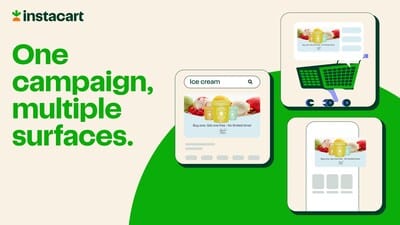
Instacart Ads is the advertising business of Instacart, which describes itself as a leading grocery technology company. It is a retail media network that owns no stores: its ads run on a marketplace of more than 2,200 retail banners, representing nearly 100,000 stores, and Instacart says it can deliver to more than 98% of households in North America. The same campaign can extend to retailer sites that use Carrot Ads, Instacart’s technology that lets retailers run their own retail media, and to Caper Carts, the smart shopping carts Instacart makes for physical stores.
Instacart reports its ad business as one line, “advertising and other revenue”, and says substantially all of it is advertising. The line reached $1,065 million in 2025, up 11%, and grew 16% in each of the first two quarters of 2026. Instacart forecast growth of 15% to 18% for the third quarter. More than 9,000 brands advertised at the end of 2025.
Instacart’s own reach figure is more than 55 million unique visitors to the Instacart Ads ecosystem over 12 months, measured by Comscore. For the network at a glance, see our Instacart Ads network profile.
Instacart Ads news
Instacart Ads news: what changed in 2026 and what it means for 2027
Newest first, April to September 2026. The changes that matter most to advertisers: every campaign now picks a Scope, Gopuff runs Carrot Ads, Immersive Feed brought vertical shoppable video, and Ads Manager added a Grow objective.
- New inventory
Gopuff adopts Carrot Ads
Gopuff will join the Instacart Marketplace and use Carrot Ads for its own U.S. storefront. Brands will be able to extend Instacart Ads campaigns to Gopuff and BevMo! shoppers, or buy Gopuff-only campaigns through their Instacart team. Instacart now counts more than 310 Carrot Ads partners.
- In store
Shelf data for brands
Instacart announced the Store Excellence Portal, which shows brands daily store-level shelf data and estimates of sales lost to out-of-stocks. It is rolling out with select grocers and brands.
- Ads Manager
Every campaign now picks a Scope
Every new sponsored product, display and shoppable display campaign now asks you to choose a Scope: the whole Instacart Ads ecosystem, or partner-specific ads for one partner. Reports filter by campaign scope. Spotlight collections on Pages retired on September 21, and the 4:5 small-screen banner on Pages retires on November 11, 2026.
- AI
Clementine, Instacart’s shopping assistant
Instacart launched Clementine, an AI shopping assistant, across the U.S. and Canada. TechCrunch reports it will surface relevant deals and promotions. Instacart’s announcement says nothing about ads; in June, Marketing Dive reported that Instacart would likely start testing ads in its assistant in the second half of 2026.
- Earnings
Second quarter: advertising and other revenue up 16%
The line reached $297 million, up 16% from $255 million, ahead of the 11% to 14% growth Instacart had forecast. Instacart said AI recommendations in Ads Manager are now available to all advertisers, and it opened Pinterest self-service campaigns to all its brand partners.
- Ads Manager
No three-product minimum, and “Buy now” is out
Shoppable display and video ad groups no longer need at least three products (40 is still the limit), and “Buy now” moved to the list of calls to action Instacart does not accept.
- New format
Immersive Feed and Ads Studio
At Cannes, Instacart introduced Immersive Feed, a vertical, shoppable video feed of meals and recipes that brands book in Ads Manager. It launched as a pilot, with brands including Hellmann’s and Siete Foods. Trade press reported a second launch, Ads Studio, a creative service powered by Local Produce, Instacart’s in-house agency.
- Ads Manager
A Grow objective, and Acquire for display
Ads Manager added a Grow objective, aimed at repeat purchases, and opened the Acquire objective to display ads. On its August earnings call Instacart said it had begun testing Grow, so it may not appear in your account yet.
- In store
Weis Markets adds Caper Carts with ads
Weis Markets began rolling out Caper Carts in Pennsylvania and said it will launch on-cart advertising. Caper Carts are live in more than 100 cities.
- Ads Manager
Retailers can now advertise too
Instacart opened Ads Manager to retailers, starting with basket-level promotions, which reached general availability on July 15. Retailers now compete with brands for some of the same shopper attention, and Instacart plans sponsored placements for them during 2026.
- Earnings
First quarter: fastest growth since 2023
Advertising and other revenue reached $286 million, up 16%, Instacart’s fastest growth in the line since the third quarter of 2023.
- Ads Manager
An audience step for display
Display campaigns gained an Audience step and, for Optimized performance campaigns, a report that splits results into shoppers new to the category, new to the brand, and repeat buyers.
What you can buy
Instacart ad formats
Instacart sells five self-serve ad formats in Ads Manager, a free brand destination called Pages, brand promotions and a set of managed placements. Instacart display ads come in four kinds, all bought per thousand impressions: shoppable display, shoppable video, display banners and recipe ads. In this guide “display” covers all four, and “display banners” means the banner format. Sponsored products, display banners and shoppable display can also run on Carrot Ads partner sites, and eligible shoppable display on Caper Carts.
Sponsored products
- Search results, aisles, the home page and other browse pages
- Cost per click, second-price auction
- Live by noon Pacific on the start date
Your product appears as a sponsored tile among regular results. Instacart, which used to call the format featured product ads, said in 2024 that the top three sponsored slots take nearly 70% of sponsored product clicks.
Shoppable display
- Search results; eligible campaigns also on Caper Carts
- Cost per thousand impressions, first price, from $15
- Review within three business days
A lifestyle image, your logo and a tagline sit above a row of your products that shoppers can add to cart, up to three on mobile and five on desktop, from up to 40 in the ad group.
Shoppable video ads
- Search results and audience placements
- Cost per thousand impressions, first price, from $15
- Review within three business days
A 16:9 video of 3 to 30 seconds with a product carousel.
Display ads
- Storefront, departments, aisles and search results
- Cost per thousand impressions, first price, from $15
- Review within three business days
A display banner that links to one of your Pages. It is meant for awareness, and Instacart counts sales for 14 days after a view or a click.
Recipe ads
- Search results, the storefront and collections
- Cost per thousand impressions, first price, from $15
- Review within three business days
Part of Inspiration Ads: a recipe that features up to 40 of your products as ingredients. Instacart says recipe ads averaged 43% new-to-brand sales and 78% of impressions outside the product’s own aisle in its 2025 third-quarter campaigns. Occasion ads, which feature a product collection and have no self-serve setup guide, averaged 36% and 90% on the same measures. Immersive Feed, a 9:16 shoppable video feed of 5 to 30 seconds, is also an Inspiration ad booked in Ads Manager; it launched as a pilot in June 2026, and in August Instacart said it was available on Instacart.
Pages
- A brand, sub-brand or custom category page, evergreen or seasonal, with its own web address
- Free
- Review within 72 hours
The destination for display and video ads, and a page you can link from your own site and social profiles. Each brand or sub-brand can have one evergreen Page, which Instacart recommends refreshing every 90 days, plus seasonal Pages.
Brand promotions
- On eligible products, at the shopper’s chosen retailer
- A fee plus the discount, per redemption
- Live at midnight Pacific on the start date
Offers such as “Spend $X, save $Y” or a free gift, set up under Library, then Promotions. A shopper can redeem a brand’s promotion once every 30 days, and a promotion’s budget cannot be lowered once set.
Managed placements and off-platform media
- Home page banners, email and push, retailer storefront banners, promo codes, and partners’ platforms
- Order form, or the partner’s pricing
- Agree with your Instacart team
Order-form placements are sold through Instacart’s sales team. Off-platform campaigns run as a managed service or self-service, using Instacart’s first-party audiences and sales measurement on partners’ platforms.
Creative specs and the rules that get ads rejected
| Asset | Spec |
|---|---|
| Display banner | Four versions: mobile 3200 x 800 (4:1) and desktop 3200 x 400 (8:1), each with and without a button; JPG or PNG, up to 2.5 MB; text at least 15 px |
| Shoppable display image | 16:9, from 1067 x 600 to 1600 x 900; JPG or PNG, up to 1 MB; minimal text |
| Tagline | Up to 29 characters; ad copy on shoppable display and recipe ads, up to 22 |
| Logo | 1:1, 120 x 120 (at least 72 x 72), up to 0.5 MB, shown as a circle |
| Shoppable video | MP4 or MOV, 3 to 30 seconds, 16:9, up to 500 MB, at least 15 frames per second, with a 16:9 thumbnail |
| Page banner | 16:9 on small screens, 4:1 on large screens |
Buttons may say “Shop”, “Shop now”, “Shop savings” or “Shop” plus your brand; “Buy now”, any label with “Add” and delivery-time promises are not accepted. Creative may not carry QR codes, web addresses or badges that look like Instacart’s own, and every image and video needs alt text that names the brand and product and repeats any text in the asset. A denied ad group can be appealed within 14 days.
Names you may have seen
Older guides mention formats you will not find in today’s help center. Universal Campaigns, which Instacart announced in March 2025 to run several formats from one budget, do not appear in the current docs, so ask your Instacart team whether your account has them. Hero banners, delivery promotions and bundles are not in Instacart’s current terms; the closest managed products are the home page banner and promo codes.
Money
How much do Instacart ads cost?
Instacart ads are priced by auction, with no minimum spend. Sponsored products are paid per click (CPC); RMIQ-managed Instacart campaigns averaged $0.53 per click in our September 2026 benchmarks. Display banners, shoppable display, video and recipe ads are paid per thousand impressions (CPM), with bids from $15. You set a daily or lifetime budget, and optimized bidding needs at least $20 a day.
New advertisers can earn a $300 click credit by running a first campaign on a new Ads Manager account. It covers sponsored products, display banners and shoppable display, and must be used within 90 days of signup. Card accounts are charged each time spend reaches a threshold, typically $500 at first, and a failed payment pauses every campaign until it clears.
On budget pacing, a sponsored product daily budget can spend up to twice the amount on a busy day, and never more than 30.4 times the daily budget in a month. Since November 2025, smart budgeting also weights sponsored product spend by time of day and day of week; Instacart says an alcohol brand’s test in the second quarter of 2025 lifted return on ad spend (ROAS) 5.5%. Display campaigns pace spend as Distributed or Accelerated. For more cost figures, see our Instacart Ads benchmarks.
The second-price auction for sponsored products
Sponsored products use a second-price auction, a form of auction-based pricing: you pay $0.01 more than the next-highest bid. Instacart ranks ads on your bid, your product’s conversion rate and other factors, so the highest bid does not always win. Each product in an ad group competes on its own.
The first-price auction for display and video
Display banners, shoppable display, video and recipe ads use a first-price auction: you pay what you bid, per thousand impressions, above a floor price of $15. One bid covers the whole ad group, and Instacart’s display and recipe docs say ad quality signals also count. Because you pay what you bid, we suggest starting near the minimum and raising the bid if delivery lags.
Self-serve, step by step
How to advertise on Instacart: your first campaign in Instacart Ads Manager
Instacart Ads Manager is Instacart’s self-serve tool for brands. These 12 steps take you from an account request to a sponsored product campaign and a shoppable display campaign, with the labels Instacart’s help center uses. Each screen is our drawing of that step, based on the help center in September 2026; your account may differ.
Before you start: have your company’s website, the brands you sell on Instacart, a card or invoicing details, and a list of product codes (UPCs). Check that each product has an image on Instacart and healthy stock, because products without images or with low stock across retailers are not shown.
Request an account
Fill in the form at ads.instacart.com: your name, company email, company name, website and country, and up to three of your top brands on Instacart. Check the box if your ads will include alcohol, and say so if you are an agency. Each country needs its own account.
Add users and billing
In Settings, User management sets each person’s access: Admin, Read-only or Custom, and whether they can use the Instacart Ads API, for managing bids and reports with software. An account can have up to five admins. Under Billing, add a card and a billing address in your country.
Claim your brand’s products
Open Library, choose Start brand setup and submit a few UPCs. Instacart replies within five business days and links your catalog. Add more products later; each batch takes up to three business days.
Create a campaign and choose its Scope
Click Create campaign. Name it and choose an objective: Maximize sales suits most sponsored product campaigns. Then choose a Scope. For a first campaign, leave it on the Instacart Ads ecosystem; partner-specific ads limit it to one partner. Pick Sponsored product as the format.
Set the budget and the bidding
Choose a daily or lifetime budget and a start date. Then choose the bid strategy. The two optimized strategies, “Optimized, maximize sales” and “Optimized, boost new-to-brand”, set bids for you against a target ROAS; they need at least $20 a day and work best with a low target, so start at or below the recommendation Ads Manager shows. Manual lets you set every bid, and lifetime budgets allow manual only. Optimized is the simpler first step. Save a draft, then click Next.
Build the ad group and add products
Name the ad group and add products by name, brand or UPC, or paste UPCs in bulk. Group products that shoppers search for the same way. Watch for Missing Product Images warnings. You cannot remove a product once the ad group is saved, only pause it.
Set the default bid and your keywords
Enter a default maximum cost-per-click (CPC) bid; Ads Manager may suggest one. It covers browse placements and the searches Instacart matches automatically. With optimized bidding, Instacart sets the bids and you do not add keywords, so skip to the next step. With manual bidding, add keywords one per line and give the important ones their own bid. Sponsored product keywords are exact match only, and there are no negative keywords.
Launch, then read the recommendations
The campaign goes live on its start date, usually by noon Pacific. If it does not, its status explains why: Incomplete ad group or Out of budget, or a product marked Unavailable image or Low in stock product. After a few days, open Recommendations. Where history allows, View landscape projects impressions, clicks, sales and spend at different bids over the next seven days, and bid strength shows how competitive each bid is.
Report every week
In Campaigns, filter by format, date and Scope, then open an ad group to see products and keywords. Export daily or aggregated data as CSV. The gear menu’s Show attribution view compares linear with last-touch credit. Review weekly, because sales keep arriving for 14 days after a click. To scale a winner, use the three-dot menu and Copy; keyword override bids copy across, default bids do not.
Build a Page for display
Display and video ads send shoppers to a Page. Open Library, then Pages, or Create a new page inside a campaign. Pick a template (Brand story, Product collections or Blank page) and add sections: product collections of up to 30 UPCs, an in-page banner or an image with text. Set the Duration to evergreen or seasonal and click Submit for review. Allow up to 72 hours.
Add a shoppable display campaign
Create a campaign with the Engage objective, your Scope and Shoppable display ad as the format. Set a total budget, the pacing and the Audience: Optimized performance, where Instacart adjusts the audience for you, or Manual. Choose up to 40 products, your Page, and a bid of at least $15 per thousand impressions. Upload a tagline of up to 29 characters, a logo and a 16:9 lifestyle image with alt text.
Choose keywords, or an audience on other formats
On shoppable display with a Manual audience, target keywords: they default to broad match, and every keyword is subject to Instacart’s approval; an “Irrelevant targeting” note means the ad will not serve on that keyword. Then submit at least three business days before the start date. Display banners, shoppable video and recipe ads under the Reach objective can also target behaviors: New to Instacart, Interactions or Purchase behaviors, with lookback windows from 30 to 180 days. Shoppable video under Engage uses keywords, and recipe ads use the Inspiration ad format with Content type Recipe.
Seven mistakes that cost money in the first month
- A high default bid, which applies to every browse placement and every search Instacart matches automatically, so you win and pay for clicks you never chose.
- Unrelated products in one ad group, which dilutes keywords that must fit every product.
- Products without images or with low stock across retailers, which cannot serve.
- A high target ROAS on optimized bidding; Instacart says it works best with a low target.
- Pausing or dayparting an optimized campaign, which starves it of data during a learning phase of about three to seven days.
- Judging keywords daily, before the 14-day attribution window has closed.
- Creative submitted on the start date; submit at least three business days ahead.
Self-serve or managed?
Everything in the steps above is self-serve, as are recipe ads and brand promotions. Home page banners, email and push, retailer storefront banners, promo codes and Gopuff-only campaigns go through Instacart’s sales team. If you would rather hand the daily bidding and keyword work to specialists, see our managed Instacart Ads service.
Keywords and bids
Instacart keyword research and bidding
Exact match only
On sponsored products a keyword matches only when a shopper types exactly that term: “ice cream” does not match “icecream” or “ice creams”. There are no broad or phrase matches and no negative keywords, so you control a costly search term through its bid. A sponsored product ad group can hold up to 8,000 keywords. Display formats differ: they offer exact, narrow and broad match, their exact match includes common synonyms and misspellings, and their ad groups have no keyword limit.
Where keywords come from
Instacart matches searches to your products automatically at the default bid. When one of those searches earns a click, it appears in your keyword list, marked as autotargeted. Use those terms, your own search data and our Instacart keyword research tool to build the list you bid on by hand.
Optimized or manual bidding
Optimized bidding sets bids for you against a target ROAS, toward maximum sales or new-to-brand sales, and you cannot add keywords or edit keyword bids. Instacart suggests running it for about two weeks before judging. In General Mills’ 2022 A/B tests with Instacart, optimized campaigns earned 7.6% more sales and 49.7% higher ROAS than manual ones. A common pattern is to launch optimized, then use its keyword data to build a manual campaign, the method in our video guide on how to take an Instacart account from 2x to 5x ROAS. See also automated bidding vs manual bidding.
Branded, category and competitor terms
Branded terms usually cost least per click and return the most, though many of those shoppers would have bought anyway. QBR Media, an Instacart partner agency, recommends keeping branded terms under 20% of budget for manual-bidding clients. Category terms such as “greek yogurt” bring new buyers at a higher cost. Perpetua reported in 2021 that competitor clicks almost always cost more than category terms. Instacart publishes no rule against bidding on competitor names, though its policies bar using another brand’s marks in your creative.
Reach beyond the marketplace
Where Instacart ads run beyond the Instacart app
Instacart campaigns can reach shoppers on other retailers’ sites and on carts in stores, and off-platform campaigns take Instacart’s audiences to social and streaming platforms.
Carrot Ads partner sites
More than 310 grocers, marketplaces and commerce platforms run Carrot Ads, Instacart’s ad technology, on their own sites, among them Hy-Vee. Gopuff announced in September 2026 that it will use Carrot Ads, and Bottlecapps said in 2025 it would bring it to more than 1,300 alcohol retailers. A campaign scoped to the Instacart Ads ecosystem can serve on these sites. The Media Rating Council extended its accreditation to Carrot Ads placements in November 2025.
Caper Carts in stores
Shoppable display campaigns that use keywords or Optimized performance extend to Caper Cart screens automatically. An impression counts once an ad has been on screen for one second. Video does not run on carts, cart results are not reported separately, and cart impressions fall outside the MRC accreditation.
Off-platform media
Instacart audiences and sales measurement are available on Google, Meta, NBCUniversal, Pinterest, Roku, The Trade Desk, TikTok and YouTube. Pinterest self-service opened to all Instacart brand partners in the second quarter of 2026, and in October 2025 Instacart announced a TikTok Ads Manager integration for select advertisers.
Putting formats together
Instacart advertising strategy: building a full funnel
Instacart’s own data supports adding display to sponsored products: on average, 50% of the shoppers reached by a brand’s display ad were not reached by that brand’s sponsored products, and more than 33% of new-to-brand sales from display came from shoppers the sponsored products missed.
- Discover Recipe ads, shoppable video, Immersive Feed, off-platform media
- Consider Shoppable display, display ads and your Pages
- Buy Sponsored products on your most searched terms
- Return Brand promotions and the Grow objective
Structure your campaigns
Build ad groups around products that share searches, price and margin, so one keyword fits every product in the group. RMIQ’s method goes further and gives each important product (SKU) its own ad group; see the Darey Brands case study and the Smash Kitchen case study. We keep one always-on campaign per product line and add seasonal campaigns on top. Avoid running identical optimized campaigns for the same products at the same time.
Plan the 2027 calendar
Instacart’s ad revenue is seasonally highest in the fourth quarter and lowest in the first, which suggests competition for holiday searches is strongest late in the year. For Thanksgiving 2027, on Thursday, November 25, we suggest working back with a buffer: products claimed and Pages approved by mid-October, display creative submitted two weeks before its start date, and optimized campaigns live by early November so learning ends well before the peak. Easter 2027 falls on March 28, in Instacart’s quietest quarter. For budget splits across networks, see how to plan your retail media budget for 2027.
Category playbooks
| Category | What to know | Where to start | Evidence |
|---|---|---|---|
| Food | Recipes put your products into meal plans and reach shoppers outside your aisle | Recipe ads, then sponsored products | JBSS’s holiday sponsored recipe: $3.12 ROAS, 67% of attributed sales new to brand (Instacart case study, 2025) |
| Seafood and pantry | Display can win new buyers in a crowded aisle | Shoppable display | Wild Planet: new-to-brand purchases up 54%, share up 2 points (Tinuiti, 2025) |
| Pet | Instacart says it is the only online marketplace with all five of the top U.S. pet retailers | Shoppable video with promotions | Reveal Pet Food: double-digit ROAS on shoppable video (Instacart, 2024) |
| Alcohol | Ads run only where Instacart determines alcohol advertising is permitted, under strict creative rules | Sponsored products, then Carrot Ads on alcohol retailers or Meta | Molson Coors on Meta: 4.2x ROAS in two weeks, 65% new to brand (Instacart, 2024) |
| Beverage | AI-built landing pages gave one early adopter more attributed sales | Pages with display | Celsius: campaign-attributed sales up 20% with AI landing pages (Instacart, 2025) |
The third column is our suggestion; the evidence comes from each brand’s case study. Alcohol creative may not show excessive or underage drinking, and weight-loss products are not accepted.
Measurement
Measuring Instacart ads: attribution, ROAS, CTR and new-to-brand
Instacart’s closed-loop attribution counts a sale when a shopper buys within 14 days of clicking a sponsored product, or of seeing or clicking a display, video or recipe ad. When several ads touch one purchase, credit is split evenly among them by default. Since April 2025, when a path mixes clicks and views, only the clicks share the credit. You can compare this linear model with last-touch credit in reports; see multi-touch attribution.
- 26 weeks A new-to-brand buyer has not bought your brand on Instacart in the past 26 weeks. Amazon and Walmart use 12 months, so new-to-brand shares do not compare across networks.
- MRC The Media Rating Council accredits Instacart’s impression and click counts for sponsored products, display banners, shoppable display and video, on web and app. Inspiration Ads and Caper Carts are outside the accreditation.
- Halo Display reports show halo sales: sales of the advertised products plus related products of the same brand, such as other flavors and pack sizes, after a view or click.
- Share The Insights Center shows your market share, customer share and basket share, and share of digital shelf shows your paid and organic share of voice on your category’s top 20 searches.
Return on ad spend depends on your category, promotions and the attribution rules above. Pacvue’s benchmarks show Instacart’s sponsored product ROAS up 7.9% year over year in the second quarter of 2026. Instacart counts click-through rate against viewable impressions, and its ads page cites a Pacvue and Helium 10 report from the fourth quarter of 2024 that puts Instacart’s CTR at twice that of the next major platform. In our September 2026 benchmarks, RMIQ-managed campaigns averaged 5.0x ROAS and a 2.11% CTR; our Instacart Ads benchmarks explain the method.
Generous rules produce generous numbers. The agency Acadia said in 2023 that it had seen ad-attributed sales on Instacart reach “north of 75%”, which it called likely too high, and suggested watching market share as well; the Insights Center shows yours next to ROAS. To test what your ads add, Instacart offers A/B tests and sales lift tests, and Data Hub, its clean room, is in pilot; for a brand-level example, see the I Eat My Greens case study.
How it compares
Instacart vs Amazon Ads vs Google Ads
Brands usually weigh Instacart against Amazon, the largest retail media network, and Google, where Instacart offers brands Shopping ads with its targeting as an off-platform channel.
| Measure | Instacart Ads | Amazon Ads | Google Ads |
|---|---|---|---|
| Advertising revenue, 2025 | $1,065M (advertising and other) | $68.6B | $294.7B |
| Search keyword matching | Exact only, no negatives (sponsored products) | Broad, phrase, exact and negatives | Broad, phrase, exact and negatives |
| Auction | Second price (sponsored products), first price (display) | A form of second price, with reserve prices | You pay what beats the ad below you |
| Default attribution | 14 days, linear across ads | 7 or 14 days, last touch | 30 days, data-driven |
Sources: Instacart, Amazon and Alphabet 10-Ks for 2025; Instacart and Google help documentation; Amazon’s statement on its auction; Intentwise’s summary of Amazon attribution; checked September 2026.
Because each network credits sales differently, a ROAS from one does not compare with a ROAS from another. Instacart’s advantages are purchase data from grocery baskets across more than 2,200 banners and one campaign that reaches Carrot Ads sites and store carts; its limits are exact-match-only keywords and no negatives on sponsored products. Compare further in our Amazon Ads guide, Walmart Connect guide, Target Roundel guide, the Amazon Ads and Walmart Connect network profiles, and the retail media guide.
Before you launch
Instacart Ads launch checklist
Progress is saved in this browser only.
Account
Products and creative
Campaign
After launch
Questions
Instacart advertising FAQ
How do Instacart ads work?
Brands bid in auctions to show products and ads in Instacart search results, aisles and the home page, and on retailer sites and in stores that use Instacart’s ad technology. Sponsored products are paid per click; display and video per thousand impressions.
How can I advertise on Instacart?
Request an account at ads.instacart.com, add users and billing, and claim your products in the Library. Then create a campaign in Instacart Ads Manager: choose an objective and Scope, set the budget and bidding, add products and keywords, and launch.
How much do Instacart ads cost?
There is no minimum spend. Sponsored products are paid per click, and RMIQ-managed campaigns averaged $0.53 per click in our September 2026 benchmarks; display ads are paid per thousand impressions, where bids start at $15. Optimized bidding needs at least $20 a day.
What is Instacart Ads Manager, and who can use it?
It is Instacart’s self-serve tool for creating, bidding on and reporting on campaigns. Brands and agencies use it, and since May 2026 retailers can run promotions in it too.
Are Instacart ads worth it for small brands?
They can be: there is no minimum spend, and new accounts can earn a $300 click credit. Instacart said mid-market and emerging brands grew their ad spend especially fast in early 2026. Start with sponsored products on a few well-stocked products.
How do Instacart ads compare with Amazon Ads?
Instacart is smaller and grocery-focused, with exact-match keywords only on sponsored products and a 14-day linear attribution model. Amazon offers more match types and negative keywords and credits the last ad touched.
What ROAS and CTR can I expect from Instacart ads?
It depends on your category, promotions and Instacart’s 14-day attribution. Pacvue reported Instacart sponsored product ROAS up 7.9% year over year in the second quarter of 2026, and RMIQ-managed Instacart campaigns averaged 5.0x ROAS and a 2.11% click-through rate in our September 2026 benchmarks.
What are the specs for Instacart display ads?
Display banners are 3200 pixels wide, at 4:1 for mobile and 8:1 for desktop, and the shoppable display image is 16:9 with a tagline of up to 29 characters. Shoppable video runs 3 to 30 seconds at 16:9.
Do Instacart ads appear outside the Instacart app?
Yes. Campaigns can extend to retailer sites that use Carrot Ads, such as Gopuff, to Caper Carts in stores, and to partners such as Pinterest, Meta and TikTok through off-platform campaigns.
Sources, checked September 2026
- Instacart (Maplebear Inc.), Form 10-K for 2025, February 2026, and Form 10-Q for the second quarter of 2026, August 2026.
- Instacart, earnings releases, remarks and calls for the fourth quarter of 2025 and the first and second quarters of 2026.
- Instacart Ads Manager help center, docs.instacart.com, pages updated August and September 2026, and the Instacart Ads API reference.
- Instacart, ads.instacart.com sign-up form and product pages, including its Comscore reach figure and a Pacvue and Helium 10 CTR comparison (fourth quarter of 2024), September 2026.
- Instacart press releases on Gopuff, Clementine, the Store Excellence Portal, Immersive Feed, Ads Manager for retailers, Weis Markets, Data Hub, Pet Supplies Plus, Carrot Ads (Hy-Vee, Bottlecapps, MRC accreditation), Universal Campaigns and TikTok, 2025 and 2026.
- Instacart case studies and blog posts: JBSS (2025), Celsius (2025), smart budgeting (2025), Reveal Pet Food (2024), Molson Coors (2024), the digital shelf (2024), General Mills and optimized bidding (2022).
- Trade press: Marketing Dive, TechCrunch and Mass Market Retailers, 2026; Stratably’s interview with Acadia, 2023.
- Tinuiti, Wild Planet case study. Pacvue, second-quarter 2026 benchmark report. Perpetua (2021, 2022), QBR Media (2025), Intentwise.
- Amazon and Alphabet, Form 10-K for 2025; Amazon Ads and Google Ads help documentation.
- RMIQ, Instacart Ads benchmarks, September 2026.
Want an expert eye on your Instacart account? RMIQ manages Instacart campaigns for CPG brands, product by product. Start with a free audit of your account, book a demo to see how RMIQ works, or try RMIQ free.