











Sponsored Products and Sponsored Brands, run for you
Amazon PPC Management, Run Search Term by Search Term
RMIQ is an Amazon PPC agency that runs your Sponsored Products and Sponsored Brands product by product, from keyword targeting to search term cleanup, with no traditional agency retainer and no setup fee.
Amazon PPC management is the ongoing work behind Amazon's cost-per-click sponsored ads: ad groups and match types, the search term report, negative keywords, bids, placement adjustments and daily budgets that Amazon does not pace through the day. Amazon calls optimization "something you should do on an ongoing basis."
The limits Amazon publishes for sponsored ads
Four Amazon numbers that set the pace of PPC work
Amazon's own guides put hard numbers on how search terms, bids, placements and budgets behave.
- 5+ orders Plus a healthy ROAS in 14 days: Amazon's cue to give a keyword its own campaign Amazon holiday guide, 2025
- 100% How far dynamic bids up and down can raise a bid, on every placement Amazon Ads, May 2025
- 900% The ceiling on a placement bid adjustment Amazon Ads, November 2024
- 100% more What one day can spend above the average daily budget Amazon Ads, May 2023
Structure, targeting, bids and budgets
What Amazon PPC management covers, lever by lever
Amazon PPC services come down to six levers inside Amazon Ads, and Amazon publishes guidance for each one.
Campaign and ad group structure
Keywords sit in ad groups and apply to every product in that ad group, so Amazon advises focused ad groups built around related themes or product types. Automatic campaigns read the product's title and description and reach shoppers through four targeting groups: close match, loose match, substitutes and complements.
Match types
Broad match reaches related searches in any order, synonyms included; phrase match keeps your words in order with extra words before or after; exact match serves only on the keyword as entered. Amazon's sequence for keyword targeting is to start broad to discover valuable search terms, then add high performers as exact match keywords.
Search terms and negative keywords
The search term report lists the shopper searches that led to at least one click on your ad. Negative keywords keep ads off the searches that waste spend and work in automatic and manual campaigns alike. RMIQ's Amazon keyword tool suggests negative phrase and negative exact candidates before a campaign launches.
Bids and bidding strategies
Dynamic bids up and down can raise a bid by up to 100% on every placement, so a $1.00 bid can cost up to $2.00 a click. The final cost per click is set in an auction and can land below that maximum, which already includes any bid adjustments.
Placements
Placement adjustments shift bids between those three placements to balance campaign performance. For a top of search push, Amazon's 2025 holiday guide pairs exact match with dynamic bids up and down and a top of search adjustment of +200% or higher.
Budgets and budget rules
Daily budgets are spent as quickly as possible, and a campaign that runs out waits until midnight. Budget rules raise a budget on a schedule, down to hours of the day, or when ROAS, click-through rate or conversion rate clears a threshold over the previous 7 days. Schedule bid rules do the same for Sponsored Products bids, down to the hour, so the two together are how dayparting works on Amazon.
Four ways out of the search term report
Where one search term goes after 14 days of clicks
Every shopper search that draws a click lands in the search term report. After two weeks of data, Amazon's own rules send it down one of four exits, and RMIQ's keyword audit sorts keywords the same way: scale, rebid or pause.
Five or more orders and a healthy ROAS
Promote it to its own exact match campaign
Amazon's harvest rule
Amazon's 2025 holiday guide moves keywords with five or more orders and a healthy ROAS in the last 14 days into their own campaigns. As an exact match keyword, the term can carry the highest of Amazon's three match type bids.
- In RMIQ's audit, scale gives a keyword more budget.
Orders, at a ROAS below target
Rebid it toward a target cost per click
Amazon's bid review
Amazon advises adjusting keyword bids on performance and reviewing them about once every two weeks. A search term that sells at too high a cost keeps its place in the account at a lower bid.
- RMIQ's rebid list lowers bids and gives a target CPC for each keyword to rebid.
Clicks and zero sales
Add it as a negative exact match
Amazon's negative rule
Amazon's guide puts it plainly: if a search term is generating clicks but has zero sales, add it as a negative exact match. The same move works in automatic and manual campaigns.
- In RMIQ's audit, pause switches a keyword off.
Many clicks across a product, few or zero orders
Fix the product page first
Amazon's listing signal
When a product draws a lot of clicks but few or zero orders, Amazon reads it as a sign that the detail page "isn't inspiring shoppers to buy." The fix starts on the listing: Amazon asks for four or more images, at least three bullet points and, for vendors and Brand Registry sellers, A+ content.
- RMIQ checks each product's Featured Offer eligibility and stock before spend.
- 7 days The data window behind Amazon's performance-based budget rules
- 14 days Amazon's harvest window for five or more orders
- 2 weeks Amazon's interval for reviewing bids and budgets
- 1 month The period over which Amazon averages a daily budget
Three ratios, three questions
ACoS, ROAS and TACoS: the numbers a PPC account answers to
Amazon defines the first two in its own guides. The third is the industry's way of setting ad spend against every sale a product makes.
ACoS: what each sale cost in ads
Amazon divides ad spend by ad revenue, so $50 of spend on $100 of sales is a 50% ACoS. Below your profit margin, the ads earn money.
ROAS: what each ad dollar returned
ROAS is the inverse, ad revenue divided by ad spend, so the same campaign returns a ROAS of 2. Amazon's harvest rule reads it over 14 days before a keyword earns its own campaign.
TACoS: ad spend against total sales
TACoS divides ad spend by total sales, ad-attributed and organic together, so it shows how much of all revenue goes to ads.
- RMIQ's Amazon reports come from Amazon's unified reporting, with return on ad spend and new-to-brand sales.
Who should hold the bid sheet
When to keep Amazon PPC in-house, and when to hand it to RMIQ
Keep it in-house when
- You advertise a handful of products and someone has time for Amazon's two-week bid and budget reviews.
- Your team already reads the search term report and adds negatives itself.
- Your budgets rarely run out before midnight.
Hand it to RMIQ when
- Each product needs its own keywords, bids and budget, and nobody has the hours to set them.
- You also advertise on Whole Foods Market or Instacart and want shared cross-network learnings.
- You want an Amazon PPC company with no traditional retainer and no setup fee.
What happens between review dates
Where self-run Amazon PPC loses money between reviews
Budgets gone before the evening
A small daily budget can be spent in a few minutes when many shoppers engage with your products, and the campaign then sits out until midnight.
Clicks that can cost up to double the bid
Under dynamic bids up and down, Amazon tells advertisers to be prepared to spend double the bid they enter.
Zero-sale searches that keep spending
A search with clicks and no sales keeps spending until someone adds it as a negative.
Automatic campaigns that never graduate
Amazon's advice is to run an automatic campaign for about two weeks, use its search term report to build manual campaigns, and keep both running.
Agents recommend, RMIQ's experts act
RMIQ as your Amazon PPC agency, inside your own account
RMIQ uses purpose-built agents to continuously optimize each product's keywords, bids and budgets. The agents analyze performance and recommend; RMIQ's experts act on what they find.
- No traditional agency retainers
- No setup fees
- You pay only when you grow, on the terms in RMIQ's pricing model
Keyword Harvesting Agent
Discovers high-potential keywords, the raw material for the scale exit in the search term cycle.
Network Optimization Agent
Recommends SKU-level keywords and bids, so a hero product and a new launch each carry their own bid strategy.
Budget Allocation Agent
Recommends budget adjustments based on campaign performance, on a lever Amazon leaves unpaced through the day.
Readiness before any spend
RMIQ confirms each advertised product is eligible for the Featured Offer and in stock before it sets keywords, bids and budget, and moves budget away from products that slip.
Search term and negative keyword cleanup
After launch, RMIQ reviews which shopper searches drew clicks, and cleanup keeps spend off the ones that do not sell.
Sponsored Brands beside Sponsored Products
For brands enrolled in Brand Registry, RMIQ runs Sponsored Brands next to Sponsored Products, where keyword targeting uses semantic matching.
Whole Foods Market ads in Amazon's ad platform
Zack's Mighty on Whole Foods Market, run by RMIQ
Zack's Mighty handed RMIQ full management of its retail media campaigns across several networks. Its Whole Foods Market ads, sold as Whole Foods Market on Amazon display ads, ran in Amazon's ad platform.
Zack's Mighty
Full management across retail media networks- ROAS on Whole Foods Market: 1x to 5x
- Sales on Whole Foods Market: 10x more
- Network-wide ROAS growth, under 2 months: 2x
Founder Zack Gazzaniga says RMIQ "more than doubled our ROAS within a month" and is "always willing to help out in any areas directly related to or tangential to sponsored search."
Read the Zack's Mighty story
The same three lists, for your account
Get scale, rebid and pause lists for your own keywords
RMIQ's keyword audit gives every keyword in your retail media campaigns a verdict: continue, adjust spend or stop. Whether your Amazon campaigns are in scope is agreed with you on the audit call.
- Scale, rebid and pause lists, with a target CPC for each keyword to rebid.
- The share of your keyword portfolio that needs action.
- Projected ROAS and sales upside, delivered in 3 business days.
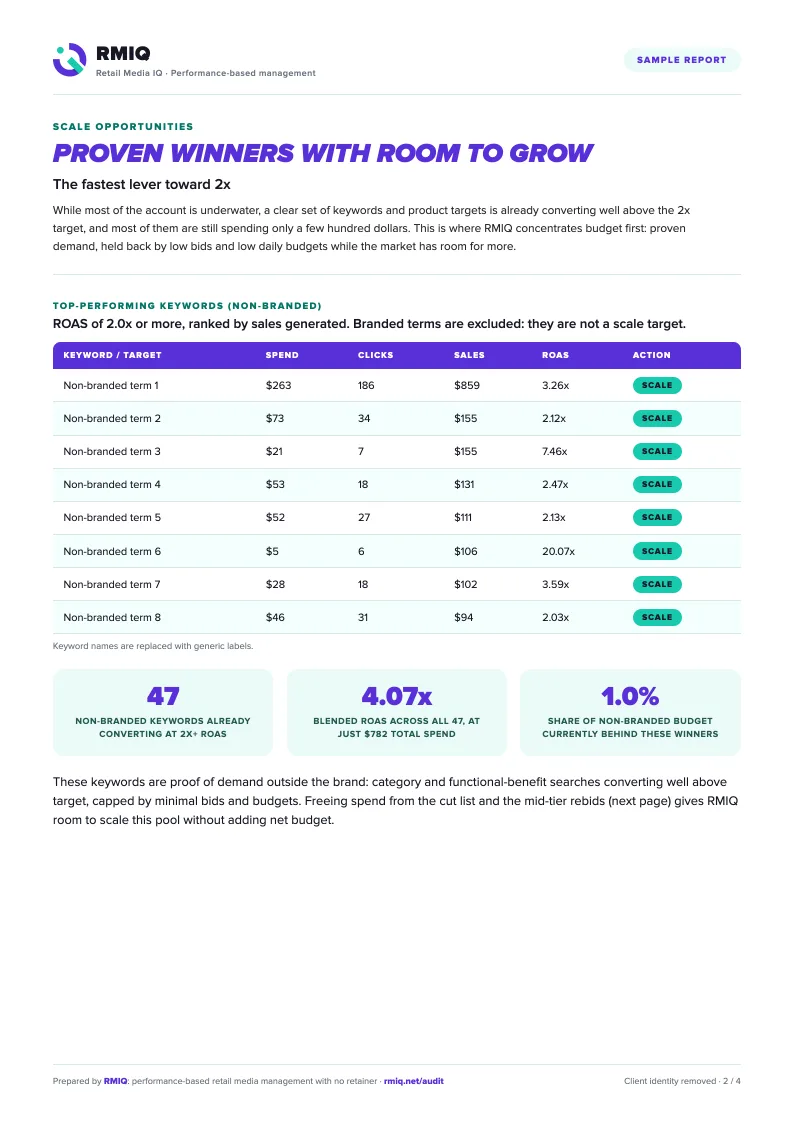
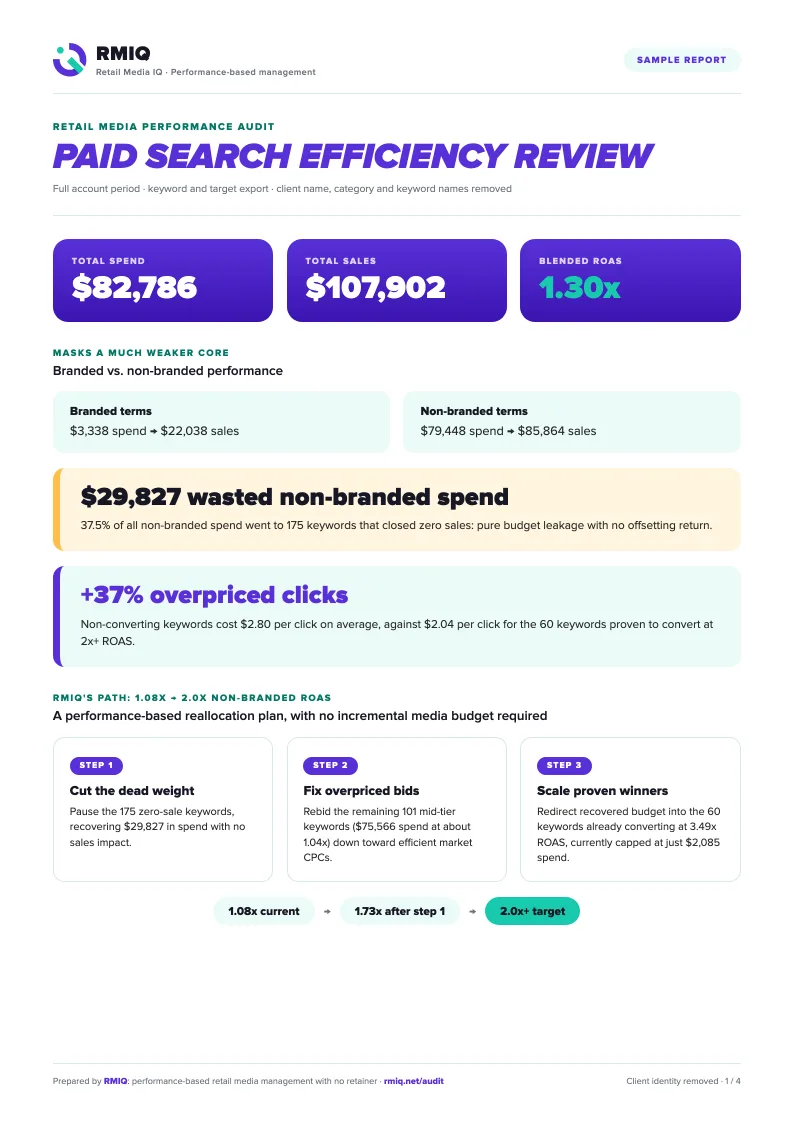
See a sample RMIQ keyword audit
An anonymized RMIQ audit of one brand's paid search, with each keyword sorted into scale, rebid and pause lists.
RMIQ's keyword audit covers Walmart Connect, Target, Instacart and more; RMIQ agrees its scope with you after the audit call.
When you download, RMIQ receives your email and may contact you about an audit. Privacy policy
Amazon PPC management, answered
Amazon PPC agency FAQ
What does an Amazon PPC agency do that Amazon's automation does not?
Amazon's auto-optimization, due in the US in January 2027, adds keywords and pauses underperforming ones within the advertiser's existing campaign settings. An Amazon PPC agency decides those settings in the first place. At RMIQ, purpose-built agents recommend SKU-level keywords, bids and budgets, and RMIQ's experts turn them into continuous optimization.
What does Amazon PPC agency pricing usually look like?
PPC agencies commonly charge a percentage of ad spend, a flat monthly retainer, and in some cases a one-time setup fee. Amazon's own managed service adds a percent-based fee to media cost, and budget minimums apply. RMIQ has no traditional agency retainer and no setup fee: you pay only when you grow, on the terms on its pricing page.
Which Amazon ad types does RMIQ's PPC management cover?
Sponsored Products and Sponsored Brands. Sponsored Products are cost-per-click ads; Sponsored Brands can run at CPC or vCPM and are open to vendors, agencies and sellers enrolled in Brand Registry. RMIQ sets keyword targeting, product targets, bids and budgets product by product, then runs search term and negative keyword cleanup.
What is a good ACoS for Amazon PPC?
Amazon says there is no single good ACoS: it depends on your industry, company size and campaign frequency. The line that matters is break-even ACoS, which sits at your profit margin. New campaigns tend to run a high ACoS because they are new, so Amazon suggests judging them on other KPIs at first.
How often should Amazon PPC campaigns be reviewed?
Amazon's own intervals are about every two weeks for bids, at least every two weeks for budgets, and at least two weeks of data before a new campaign's first review. RMIQ describes its own work on your account as continuous optimization of each product's keywords, bids and budgets.
Can Amazon PPC campaigns run on a schedule, like dayparting?
Yes. Amazon's schedule bid rules raise Sponsored Products bids at specific times of day, days of the week or date ranges, and schedule-based budget rules raise budgets down to the hour. Hourly performance reporting shows when campaigns perform best, so the rules can target those hours.
Keyword lists, guides and the networks next door
Tools and reading for the PPC work on Amazon
- Amazon keyword research tool Tool A Sponsored Products keyword list with match types, negative candidates and a bulksheet for your ad group.
- Hiring an Amazon ads agency Agency Account access, ownership and the switch from another agency.
- RMIQ's Amazon Ads guide Guide Campaign setup on Amazon, from the first campaign to reporting.
- How Amazon Ads works Network Ad types, Amazon Ads Agent and who can buy.
- RMIQ as a retail media agency Agency One team across several retail media networks.
- Budget pacing Glossary Spend spread across the day, the job Amazon leaves to you.
Other networks RMIQ runs
Amazon and RMIQ sources29 sources
Each source is listed with the date it was published or last updated; pages that show no date are marked with the date they were read.
- Amazon Ads, Sponsored ads tools for small businesses, September 22, 2026
- Amazon Ads, Unified reporting, June 8, 2026
- Amazon Ads, Holiday advertising optimization guide, September 26, 2025
- Amazon Ads, Keyword targeting guide, August 11, 2025
- Amazon Ads, Dynamic bidding for Sponsored Products, May 7, 2025
- Amazon Ads, Sponsored Products best practices, November 13, 2024
- Amazon Ads, Getting started with sponsored ads, November 12, 2024
- Amazon Ads, Measure and improve your campaigns, November 4, 2024
- Amazon Ads, Pricing transparency, February 23, 2024
- Amazon Ads, Hours of day for budget rules, November 30, 2023
- Amazon Ads, Schedule bid rules for Sponsored Products, November 6, 2023
- Amazon Ads, Improve campaign performance, August 2, 2023
- Amazon Ads, Daily budget policy update, May 9, 2023
- Amazon Ads, ROAS guide, March 3, 2023
- Amazon Ads, Sponsored Products targeting guide, October 19, 2022, read November 22, 2026
- Amazon Ads, Budget rules guide, September 16, 2022
- Amazon Ads, ACOS guide, July 12, 2022
- Amazon Ads, Sponsored Products budget best practices, July 11, 2022
- Amazon Ads, Cost per click guide, December 30, 2021
- Amazon Ads, Budget rules launch, August 12, 2021
- Amazon Ads, New advertiser guide, May 23, 2021
- Amazon Ads, Sponsored Products and Sponsored Brands product pages, no date shown, read October 14, 2026
- Amazon Ads, Whole Foods Market ad specs, no date shown, read October 9, 2026
- SupplyKick, Amazon PPC management (TACoS definition), modified September 14, 2026
- amzdudes, Amazon PPC management guide (agency pricing models), October 19, 2026
- RMIQ pricing page, October 29, 2026; technology page, modified November 4, 2026
- RMIQ keyword audit page, read October 26, 2026; Amazon keyword research tool, read November 22, 2026
- RMIQ Amazon network page and homepage, read November 2026
- RMIQ case study: Zack's Mighty, page updated November 3, 2026

Contact RMIQ
Talk to a retail media expert
Book 30 minutes with Petr, or send the team a message. A person on the team reads both.

Book a call with Petr
Petr Misek, Retail Media Expert
Bring the brands you sell and the networks you buy on. Petr will show you where RMIQ fits and what it would change.


Send us a message
Petr, Jim or Jacek will reply
Pricing, partnerships, press, or a question that doesn't need a call.